Edmund Optics Industry Solutions

Application-specific optical solutions for machine vision, life sciences, defense, semiconductor, laser systems, and research. Backed by 50+ application engineers who understand your measurement and imaging challenges.

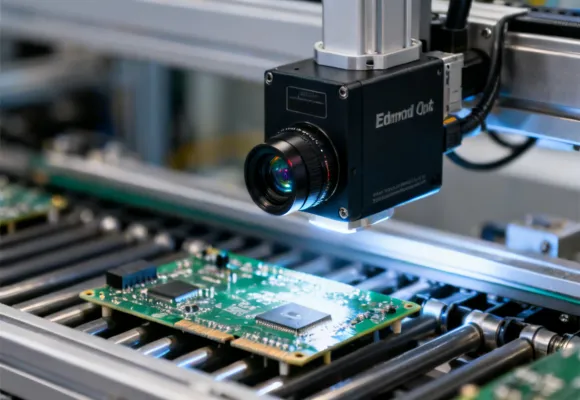
Edmund Optics machine vision imaging solution for automated PCB inspection
Machine Vision & Automation

Imaging Optics for Automated Inspection

Machine vision systems resolve defects, measure dimensions, and guide robots at production-line speeds. The imaging lens determines the resolution ceiling. Edmund Optics designs fixed focal length, micro video, and telecentric lenses optimized for the sensor formats and pixel pitches of current industrial cameras. Our application engineers calculate the required working distance, field of view, and depth of field for your specific inspection geometry, then recommend the catalog lens that meets or exceeds those optical requirements.

For systems running Sony IMX sensors at 3.45um pixel pitch, we stock lenses resolving down to 7um at the object plane. Telecentric designs eliminate perspective error in dimensional measurement applications where part height varies across the field. We supply complete imaging solutions: camera, lens, illumination, and mounting hardware specified together for guaranteed system-level performance.

  • Resolution to 7um object-space across full sensor format
  • Telecentric designs for precision dimensional measurement
  • Matched camera + lens kits for common inspection applications
Discuss Your Vision Application
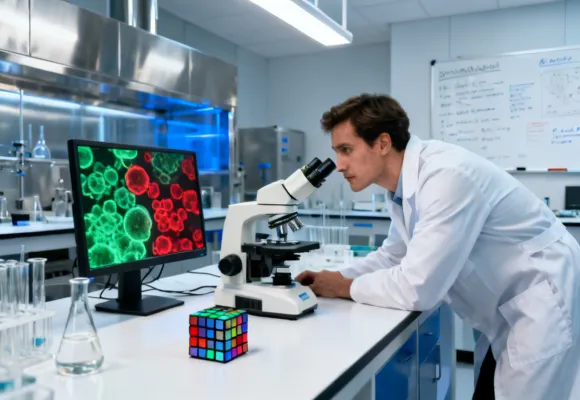
Edmund Optics fluorescence filters for life science microscopy
Life Sciences & Biomedical

Optical Filters for Fluorescence Imaging

Fluorescence imaging depends on filters that separate excitation and emission wavelengths with minimal cross-talk. Edmund Optics hard-coated interference filters achieve out-of-band blocking to OD6 (0.0001% transmission) while maintaining peak transmission above 93% at the designed passband. This performance level matters when detecting weak fluorescence signals from single-molecule FRET experiments, low-abundance biomarker assays, or autofluorescence-prone tissue samples.

Our filter sets are designed for common fluorophore combinations: DAPI/FITC/TRITC/Cy5, GFP/mCherry, and calcium indicator dyes. Multi-band and quad-band filters reduce filter changes during live-cell imaging sequences. Each filter ships with a measured spectral transmission curve, not a design-target plot. For OEM diagnostic instrument manufacturers, we provide lot-specific certificates of conformance documenting center wavelength, FWHM, and blocking performance against your incoming specification.

  • OD6 blocking with >93% peak transmission
  • Multi-band filter sets for common fluorophore panels
  • Measured spectral data and lot-specific certificates
Specify Your Filter Requirements
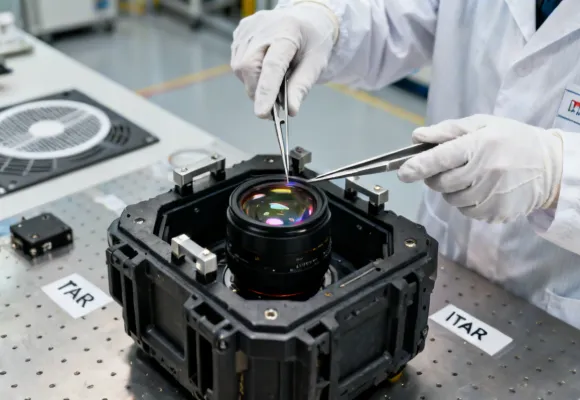
Edmund Optics ITAR-registered defense optical component assembly
Defense & Aerospace

ITAR-Registered Optics for Defense Systems

Edmund Optics is registered with the U.S. State Department DDTC under ITAR regulations. We manufacture and supply optical components for targeting, surveillance, LiDAR, head-up display, and electro-optical system integration programs. Our manufacturing facilities maintain the controlled access, personnel screening, and documentation protocols required for defense optical component production.

Infrared-transmitting materials including germanium, zinc selenide, calcium fluoride, and chalcogenide glasses are available in standard and custom configurations. We produce diamond-turned aspheric optics for MWIR and LWIR bands, precision windows for sensor protection, and beam-steering prisms for scanning systems. All defense-program deliverables include certificates of conformance with traceable lot identification and inspection data per the applicable military specification.

  • ITAR-registered with DDTC-compliant procedures
  • IR materials: germanium, ZnSe, CaF2, chalcogenides
  • Diamond-turned aspherics for MWIR and LWIR applications
Request Defense Procurement Consultation
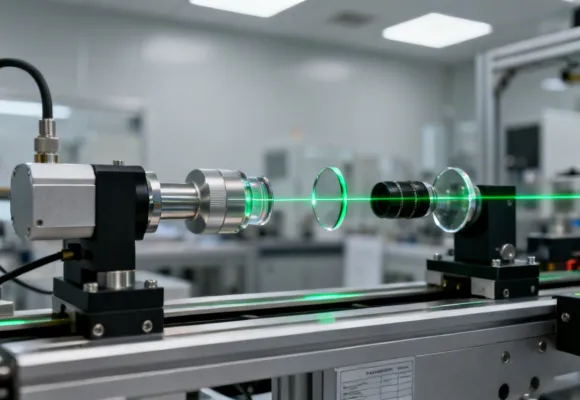
Edmund Optics laser beam delivery and conditioning optics
Laser Systems & Photonics

Beam Delivery and Conditioning Optics

Laser systems require optics that handle high power density without wavefront degradation, surface damage, or thermal lensing. Edmund Optics supplies laser-grade windows, beam expanders, focusing lenses, and steering mirrors with damage thresholds tested per ISO 21254. Our LIDT data is published at specific pulse durations and repetition rates, not extrapolated from scaling laws.

Beam expanders from 2x to 20x magnification maintain beam quality (M-squared) through achromatic Galilean or Keplerian designs. We stock laser-line bandpass filters for common wavelengths (355nm, 532nm, 632.8nm, 1064nm, 1550nm) and design custom filters for OEM laser instrument manufacturers. Application engineers assist with thermal modeling for high-average-power systems where substrate absorption and mount conductance affect wavefront stability.

  • LIDT tested per ISO 21254 at specified pulse parameters
  • Beam expanders 2x-20x maintaining M-squared quality
  • Laser-grade coatings for UV through SWIR wavelengths
Discuss Your Laser Optical Requirements

Where Standard Catalog Optics Fall Short

Optical components have defined performance boundaries. Knowing where standard solutions are insufficient prevents costly design iterations and failed prototypes.

High-Energy Pulsed Laser Applications

Standard catalog AR coatings are designed for CW or low-repetition-rate lasers. At pulse energies above approximately 1 J/cm2 at nanosecond durations, standard coatings risk damage. Pulsed applications require purpose-designed laser-grade coatings with published LIDT values tested per ISO 21254 at the specific pulse width and repetition rate of your laser. Specifying standard optics for pulsed systems is a common and expensive mistake — coating failure can contaminate the laser cavity or downstream optics.

Extreme Temperature & Vacuum Environments

Catalog optical filters and coated optics are rated for -50C to +80C operating temperature. Aerospace, cryogenic, or high-power industrial applications outside this range require special substrate-coating combinations to manage thermal mismatch. Vacuum environments present outgassing concerns with certain adhesives and anti-reflection coatings. If your system operates outside standard temperature and pressure ranges, specify your environmental conditions upfront so we can validate material compatibility before quoting.

Deep UV Below 200nm

Edmund Optics stocks UV-grade fused silica optics transmitting down to approximately 185nm. Below 200nm (vacuum UV), standard optical glasses including fused silica become increasingly absorptive. Applications in VUV spectroscopy, EUV lithography, or excimer laser processing at 157nm or 193nm require calcium fluoride (CaF2) or magnesium fluoride (MgF2) substrates with specialized handling and coating processes. Our custom manufacturing program can accommodate VUV materials, but these fall outside standard catalog specifications and require extended lead times.

Adaptive or Deformable Optics

Our product range covers fixed-geometry optical components: lenses, filters, prisms, windows, and static mirror assemblies. We do not manufacture deformable mirrors, spatial light modulators, or adaptive optics systems with active wavefront correction. Customers integrating adaptive optics for atmospheric compensation, ophthalmology, or laser beam cleanup should source the deformable element separately and contact us for the fixed relay and imaging optics in the surrounding optical train.

Application Not Listed Here?

Our 50+ application engineers handle 30,000+ technical inquiries per year across dozens of industries. Describe your optical challenge and we will identify the right components or design a custom solution.

Request a Technical Consultation